The Owl and the Pussycat
A pea-green boat, a runcible spoon and a dance by the light of the moon
Listen
Arrangement: Ian J. Watts / Mike Wilbury · Singalongasong Band / ClassicRocks
Lyrics
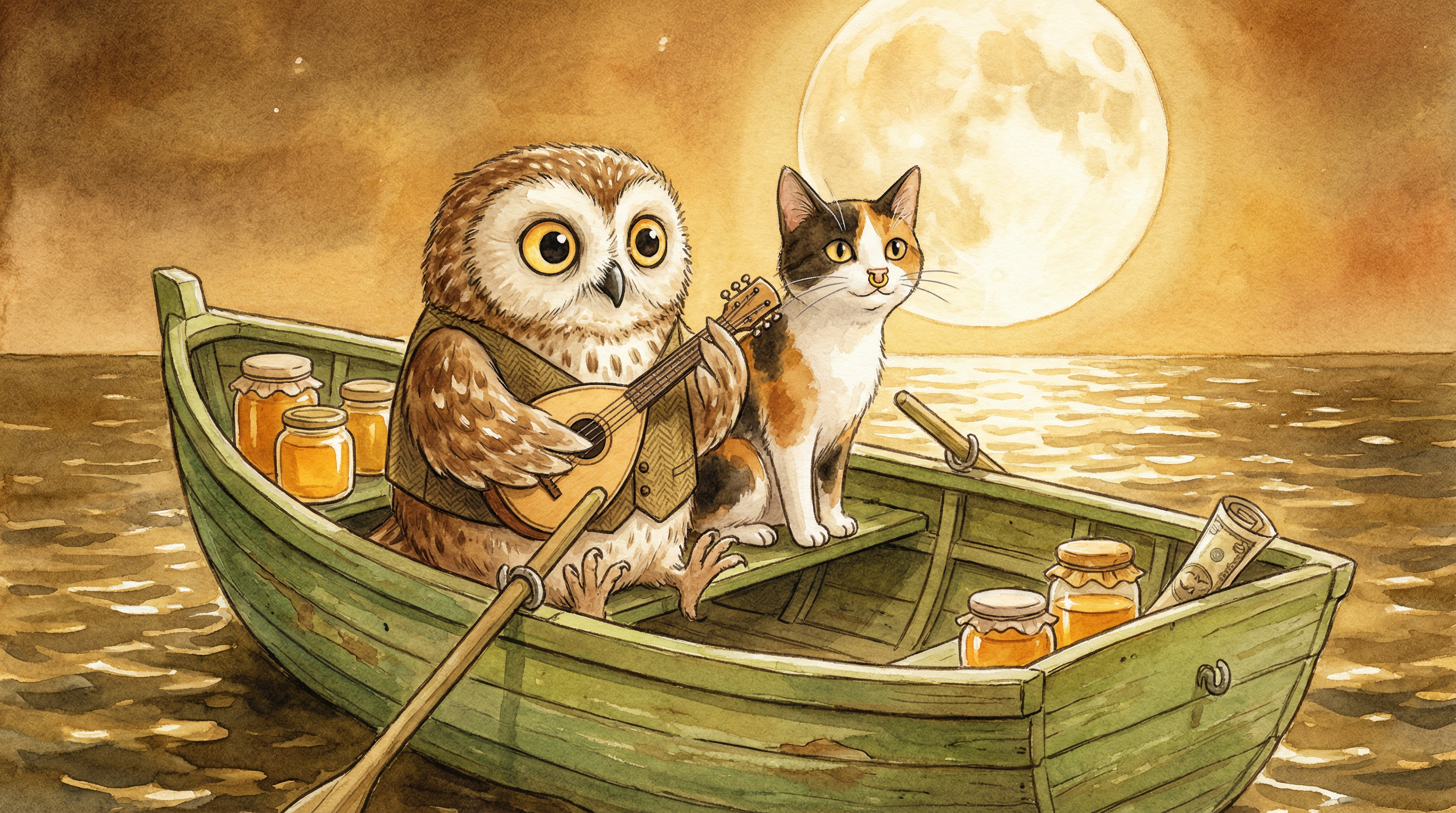
The Owl and the Pussycat went to sea
In a beautiful pea-green boat.
They took some honey, and plenty of money,
Wrapped up in a five-pound note.
The Owl looked up to the stars above
And sang to a small guitar,
"O lovely Pussy! O Pussy, my love,
What a beautiful Pussy you are, you are,
What a beautiful Pussy you are!"
Pussy said to the Owl, "You elegant fowl,
How charmingly sweet you sing.
O let us be married! Too long we have tarried;
But what shall we do for a ring?"
They sailed away, for a year and a day,
To the land where the Bong-tree grows,
And there in a wood a Piggy-wig stood
With a ring at the end of his nose, his nose,
With a ring at the end of his nose.
"Dear Pig, are you willing to sell for one shilling
Your ring?" Said the Piggy, "I will."
So they took it away, and were married next day
By the Turkey who lives on the hill.
They dined on mince, and slices of quince,
Which they ate with a runcible spoon.
And hand in hand, on the edge of the sand,
They danced by the light of the moon, the moon,
They danced by the light of the moon.
Traditional lyrics — public domain. Arrangement © Singalongasong Band / ClassicRocks.
History & Background
History & Origin
"The Owl and the Pussycat" was written by Edward Lear and first published in 1871 in his collection "Nonsense Songs, Stories, Botany and Alphabets". Lear was the originator of the literary nonsense poem — he had already published "A Book of Nonsense" in 1846 — and "The Owl and the Pussycat" stands as perhaps his finest single piece: a complete story in three stanzas, with its own geography, characters, and vocabulary.
The poem invents several things that have become part of the English language: the "runcible spoon" (a word Lear used in several poems; spoons with wide, rounded bowls are now actually called runcible spoons); the "Bong-tree" (entirely fictitious, but universally understood as a tree on a remote island); and the land beyond the sea where everything necessary for a wedding can be found.
The romance between an owl and a cat is treated with complete seriousness. Their love is genuine, their problem (no ring) practical, their solution (ask a pig) creative, and their wedding (performed by a turkey on a hill) legally sufficient. The final image — dancing by the light of the moon — is one of the most beautiful in children's literature, combining moonlight, sand, music, and the simple human act of dancing with someone you love.
The poem has been set to music many times; our arrangement gives it the lyrical treatment it deserves.