Little White Duck
Sitting in the water doing what he oughter — the happiest duck in the pond
Listen
Arrangement: Ian J. Watts / Mike Wilbury · Singalongasong Band / ClassicRocks
Lyrics
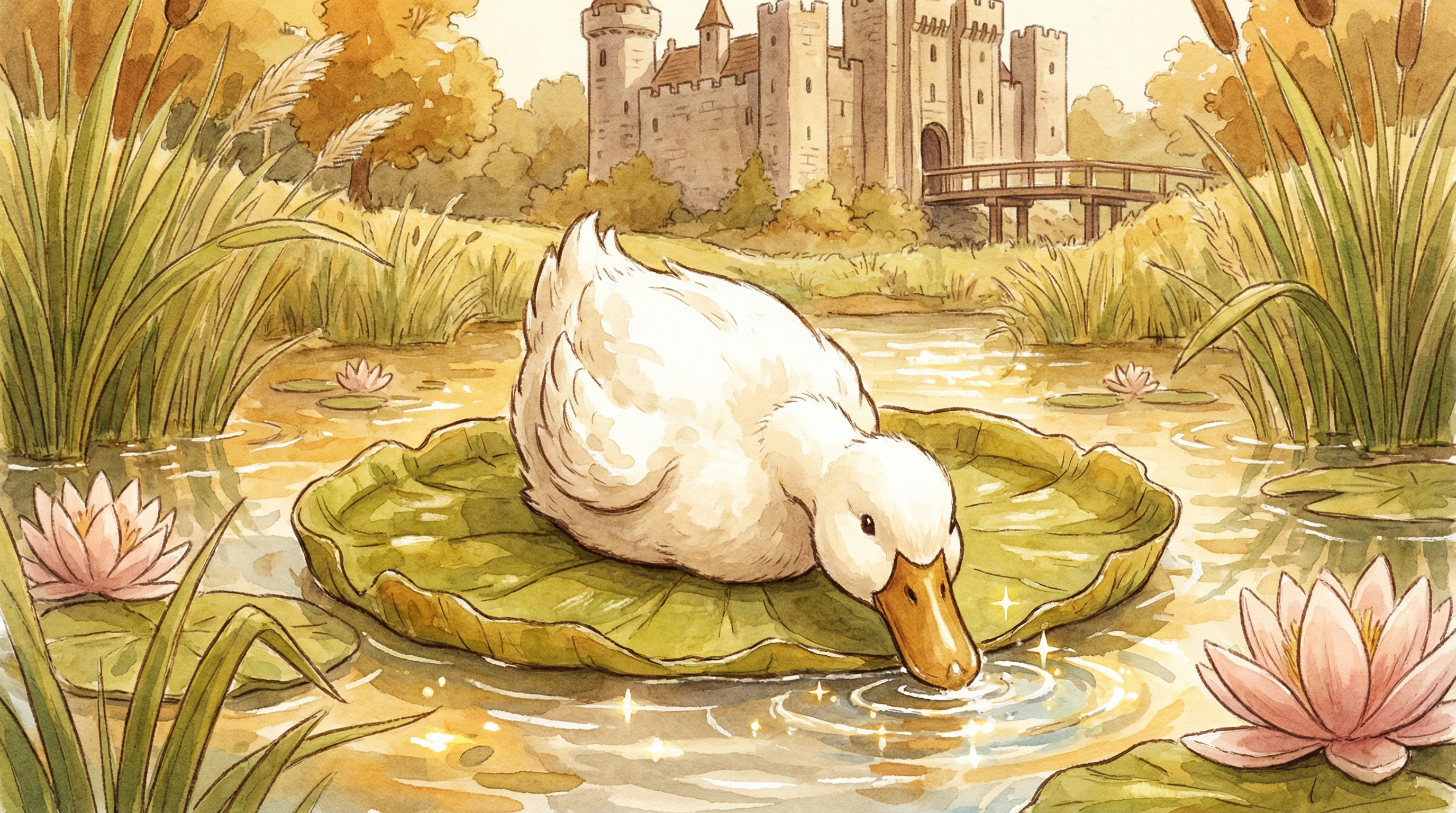
There's a little white duck sitting in the water,
A little white duck doing what he oughter.
He took a bite of a lily pad,
Flapped his wings and he said, "I'm glad
I'm a little white duck sitting in the water."
Quack, quack, quack.
There's a little green frog swimming in the water,
A little green frog doing what he oughter.
He jumped right off of the lily pad,
That little frog was so very glad,
A little green frog swimming in the water.
Glug, glug, glug.
There's a little black bug floating on the water,
A little black bug doing what he oughter.
He tickled the frog on the lily pad
That the little frog said, "I'm so very glad,
There's a little black bug floating on the water."
Chirp, chirp, chirp.
There's a little white duck sitting in the water,
A little white duck doing what he oughter.
He said, "I'm glad I'm a little white duck,
I'm the happiest duck in this whole wide muck."
A little white duck sitting in the water.
Quack, quack, quack.
Traditional lyrics — public domain. Arrangement © Singalongasong Band / ClassicRocks.
History & Background
History & Origin
"Little White Duck" was written by Walt Barrows (lyrics) and Bernard Zaritzky (music), and first published in 1950. It was originally performed by Danny Kaye (who also recorded "Inchworm" and "Thumbelina"), and his recording brought the song to wide attention across the English-speaking world.
The song follows a satisfying ecological chain: the duck sits in the pond eating lily pads, the frog jumps from the same lily pad, and a small black bug floats on the surface tickling the frog. Each creature is introduced as doing "what he oughter" — what it ought to, what is natural and right for it. The word "oughter" is a deliberate piece of friendly bad grammar, the kind that children immediately recognise as playful.
The duck's declaration of gladness — "I'm glad I'm a little white duck sitting in the water" — is one of the simplest and most direct expressions of contentment in children's music. It requires no explanation or qualification: the duck is glad precisely because it is what it is, doing what it does, in the place it belongs.
Each verse adds a new inhabitant to the pond, building a small community of creatures who are all, in their different ways, exactly where they should be. The closing verse returns to the duck, who speaks for all of them: glad to be alive, glad to be there, quacking contentedly in the water.