Little Robin Redbreast
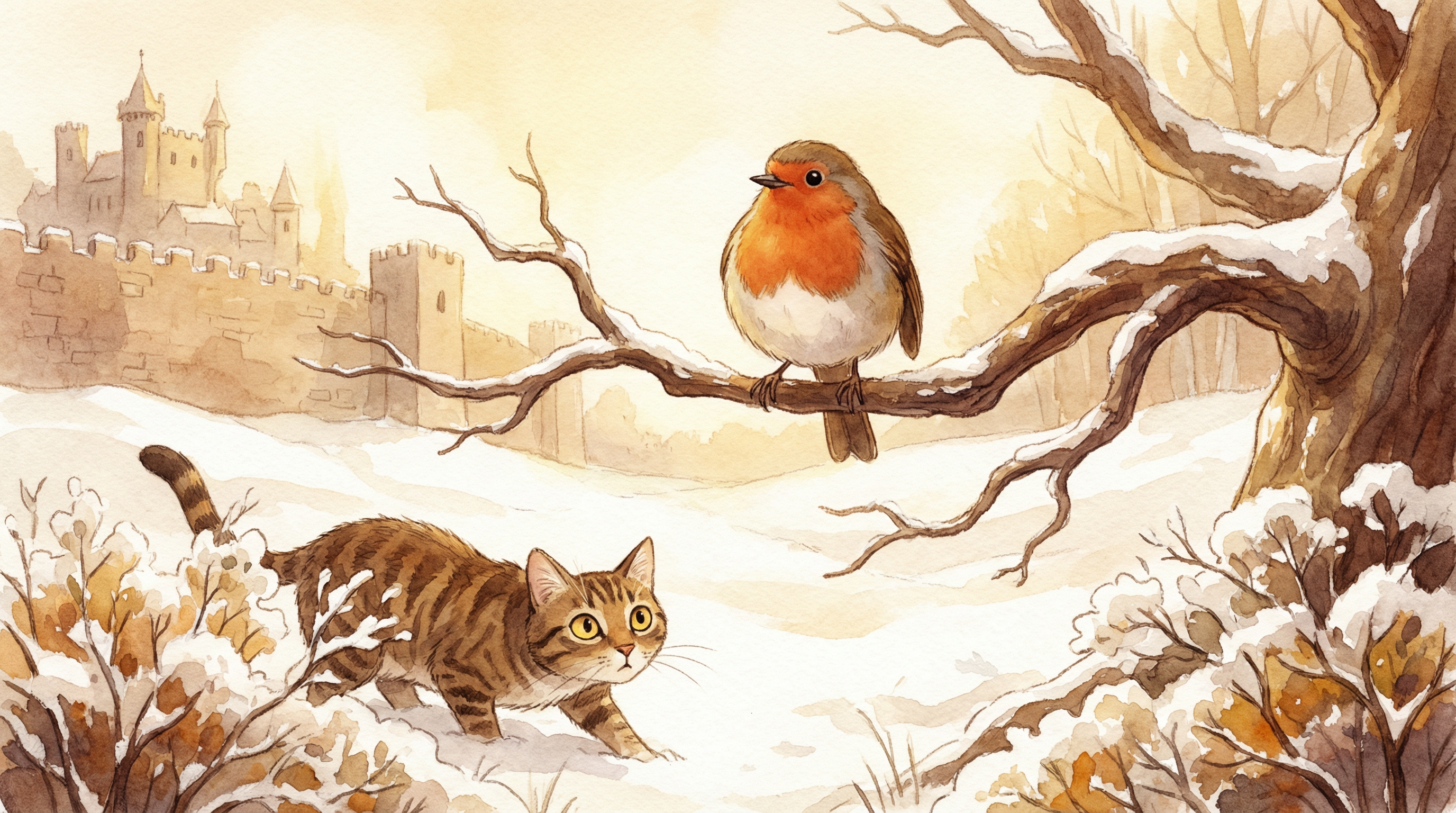
A game of chase between a quick robin and a determined pussy cat
Listen
Arrangement: Ian J. Watts / Mike Wilbury · Singalongasong Band / ClassicRocks
Lyrics
Little Robin Redbreast sat upon a tree,
Up went pussy cat and down went he.
Down came pussy cat and away Robin ran,
Said little Robin Redbreast, "Catch me if you can!"
Little Robin Redbreast jumped upon a wall,
Pussy cat jumped after him and almost had a fall.
Little Robin chirped and sang, and what did pussy say?
Pussy cat said, "Meeow!" and Robin jumped away.
Little Robin Redbreast sat upon a tree,
Up went pussy cat and down went he.
Down came pussy cat and away Robin ran,
Said little Robin Redbreast, "Catch me if you can!"
Traditional lyrics — public domain. Arrangement © Singalongasong Band / ClassicRocks.
History & Background
History & Origin
"Little Robin Redbreast" is a traditional English nursery rhyme that captures one of the most familiar scenes in garden life: the game of pursuit between a cat and a bird that the bird always wins. Robins are notoriously bold — they will perch close to humans and are known to follow gardeners — and a robin that taunts a cat with "catch me if you can" is entirely in character.
The rhyme has been in circulation since at least the early nineteenth century, though its precise first printing is difficult to establish. It belongs to a group of nursery rhymes featuring the robin, who appears throughout English folk tradition as a friendly and sympathetic bird — the bird that covered the babes in the wood with leaves, the bird whose breast turned red from the blood of Christ, the bird who delivers the post on Christmas cards.
In this rhyme, the robin is specifically playful, enjoying the chase rather than fleeing in fear. The pussy cat, for all its athleticism, "almost had a fall" jumping after the bird on a wall, and its final "Meeow!" has the quality of frustration rather than threat.
The two-verse structure — tree, then wall — gives the chase geography and movement, and the return to the opening image at the end creates a pleasing circularity: the game will begin again.