Listen
Arrangement: Ian J. Watts / Mike Wilbury · Singalongasong Band / ClassicRocks
Lyrics
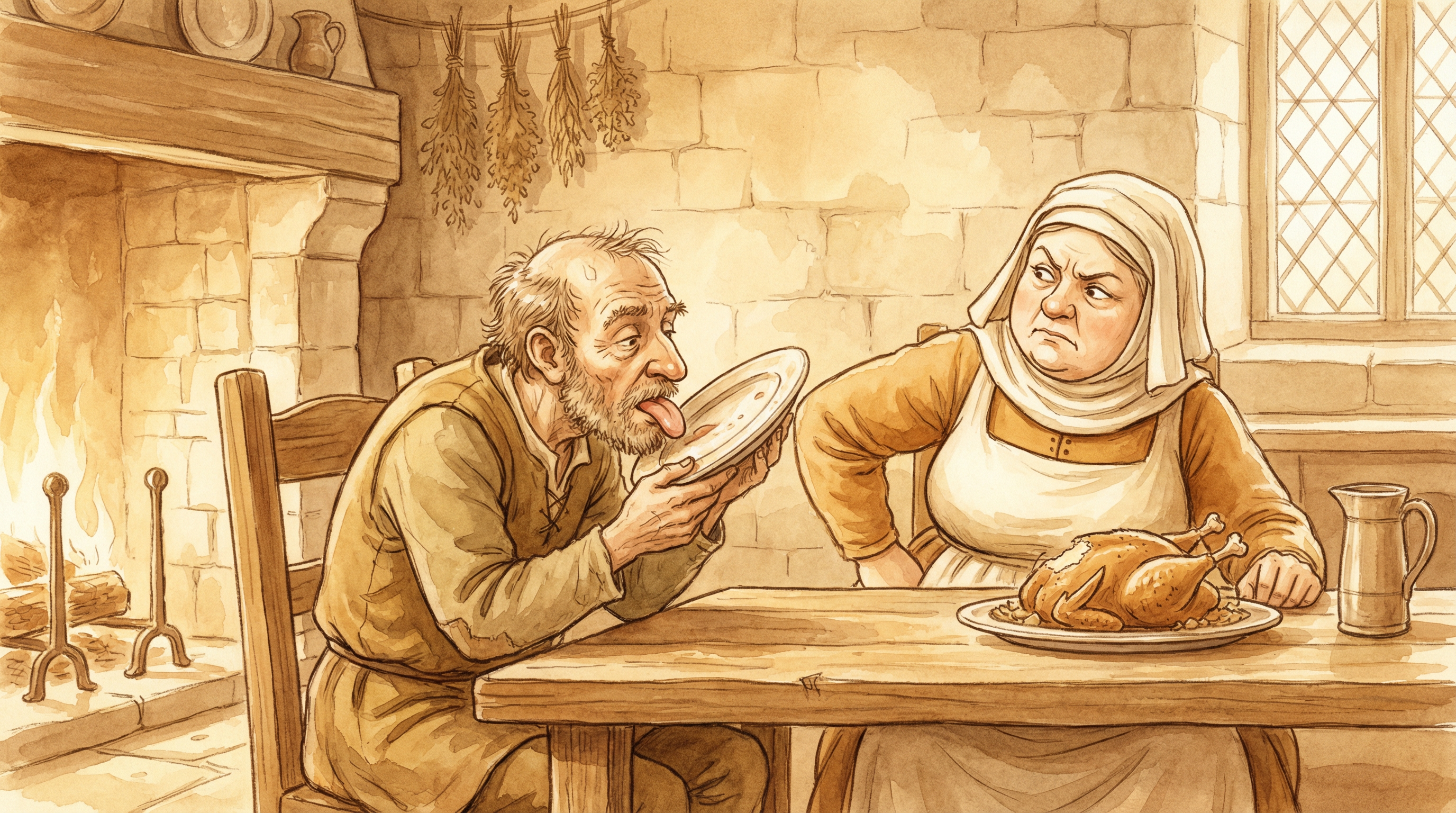
Jack Sprat could eat no fat,
His wife could eat no lean,
And so betwixt the two of them
They licked the platter clean.
Traditional lyrics — public domain. Arrangement © Singalongasong Band / ClassicRocks.
History & Background
History & Origin
"Jack Sprat" is one of the shortest nursery rhymes in the English canon, and one of the most satisfying in its comic logic. The rhyme first appeared in print in 1639 in Paroemiologia Anglo-Latina, a collection of English proverbs, where a version of it was used as a saying about a married couple with complementary but opposing tastes.
The rhyme is built on the kind of practical folk wisdom that delights in neat solutions to domestic problems: two people with opposite dietary restrictions together consume exactly one complete meal, leaving nothing behind. The image of both of them licking the platter clean has a gleeful thoroughness to it.
"Jack Sprat" was used as a name for a small, thin person in the sixteenth and seventeenth centuries — a "sprat" being a small herring — so the name itself signals the character's leanness even before the rhyme begins. His wife, by contrast, is implicitly well-fed and round.
Some commentators have tried to link the rhyme to specific historical figures — Cardinal Wolsey and Henry VIII, or various other fat-and-thin political pairs — but none of these identifications is convincingly supported by evidence. The rhyme works perfectly well as a simple character sketch: two people, one dish, a happy result.