Listen
Arrangement: Ian J. Watts / Mike Wilbury · Singalongasong Band / ClassicRocks
Lyrics
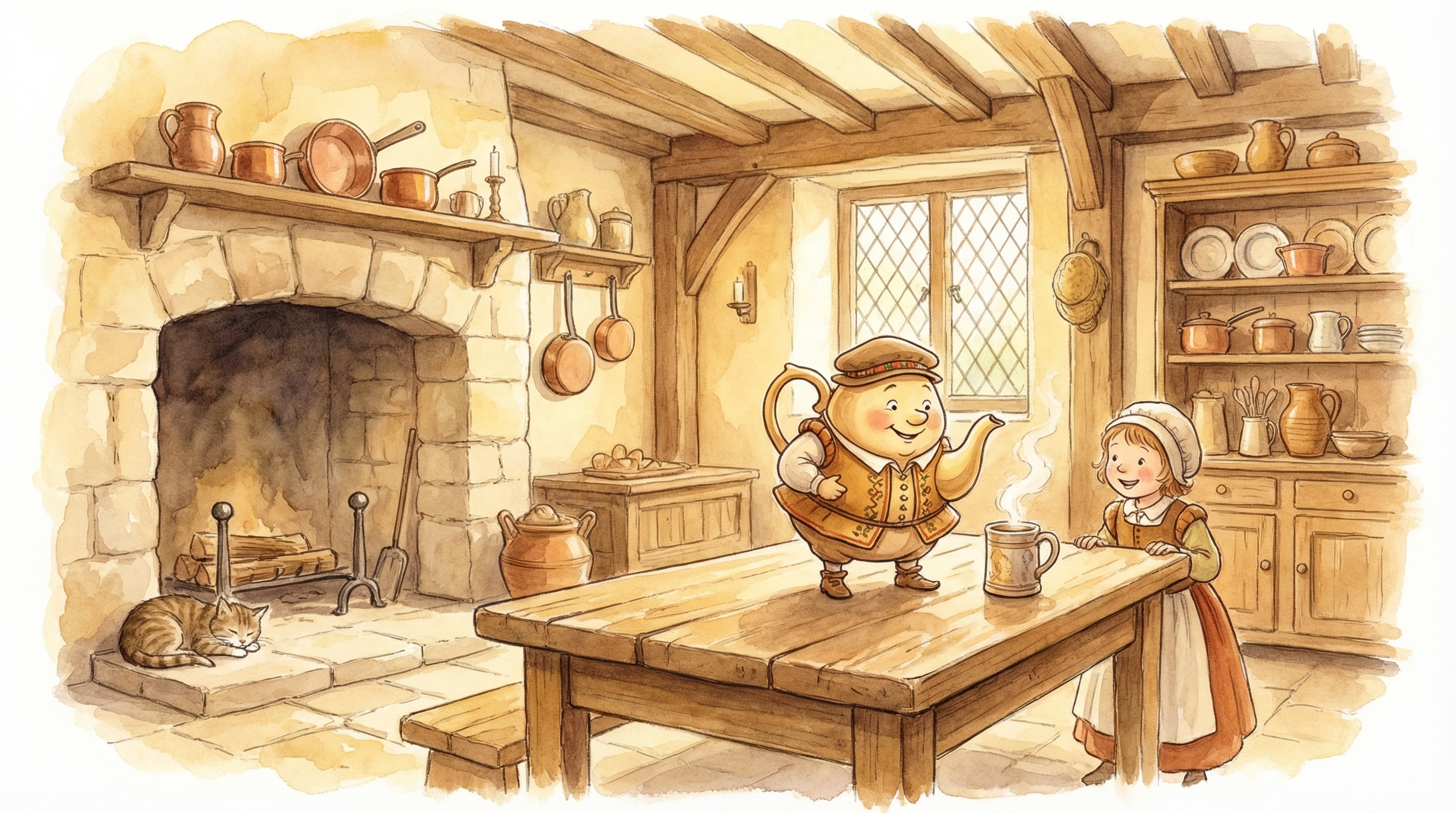
I'm a little teapot,
Short and stout.
Here's my handle,
Here's my spout.
When I get all steamed up,
Hear me shout:
Tip me up and pour me out!
I'm a very special pot,
It's true.
Here is an example
Of what I can do.
I can turn my handle
Into a spout,
Just tip me up
And pour me out.
Traditional lyrics — public domain. Arrangement © Singalongasong Band / ClassicRocks.
History & Background
History & Origin
"I'm a Little Teapot" was written by George Harold Sanders and Clarence Z. Kelley, first published and performed in 1939. Sanders was a dance teacher who created the song as an action song for his students, and it spread rapidly through the American school system before crossing the Atlantic.
The song is performed with accompanying actions: one arm forms the handle (bent at the elbow, hand on hip), the other forms the spout (arm extended outward). At the line "tip me up and pour me out", the child tilts sideways, the spout arm pointing downward as if pouring. It is one of the simplest and most effective action songs ever written, requiring minimal instruction and producing maximum participation.
The teapot in British domestic life occupies a position of near-sacred importance. The kettle may boil the water, but the teapot makes the tea, and the tea is the cornerstone of daily life from breakfast to bedtime. A song that asks a child to become a teapot is, in the British context, asking them to embody something genuinely central to the culture.
The second verse, which imagines the teapot turning its handle into a spout, introduces a pleasingly absurd flexibility into the teapot's character. Our rock arrangement gives the small, stout teapot considerably more energy than its shape might suggest.