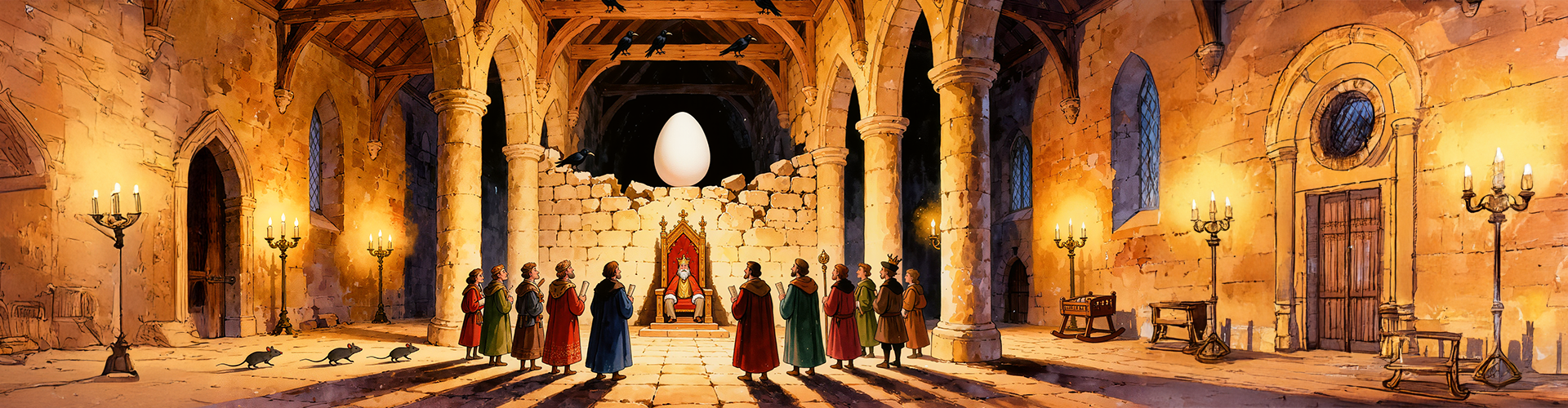
Humpty Dumpty
The Defeat of Charles I, King of England and Scotland
Listen to Humpty Dumpty →Humpty Dumpty sat on a wall,
Humpty Dumpty had a great fall,
All the King's horses, and all the King's men
Couldn't put Humpty together again!
Eggs in general don't become very famous very often, because they all look the same. In order to become famous there must be some distinguishing features. With eggs there are no distinguishing features — or, if we want to be as accurate as Humpty Dumpty himself, there are very few. We all know Humpty Dumpty, sitting on a wall and taking it for granted that he is the most famous egg on earth.
Humpty Dumpty is a very special case. Although he is famous, we know very little about him — perhaps even nothing. He is famous despite the fact that we know as much about his character as we do about any other egg. We don't even know when he appeared for the first time. We do know that he existed before 1862, the year Alice in Wonderland was published, because when Alice met him she already knew him:
…and when she had come close to it, she saw clearly that it was HUMPTY DUMPTY himself. "It can't be anybody else!" she said to herself. "I'm as certain of it, as if his name were written all over his face."
The only thing we know concerning his character is the fact that he had none. And that's not very nice! Despite being a characterless egg, according to Lewis Carroll, people are nothing but eggs.
"I shouldn't know you again if we did meet," Humpty Dumpty replied in a discontented tone, giving her one of his fingers to shake. "You're so exactly like other people."
"The face is what one goes by, generally," Alice remarked in a thoughtful tone.
"That's just what I complain of," said Humpty Dumpty. "Your face is the same as everybody has — the two eyes, so —" (marking their places in the air with his thumb) "nose in the middle, mouth under. It's always the same. Now if you had the two eyes on the same side of the nose, for instance — or the mouth at the top — that would be some help."
"It wouldn't look nice," Alice objected. But Humpty Dumpty only shut his eyes and said "Wait till you've tried."
Being an egg himself, he sees nothing but eggs. Have you ever thought about that? That an egg sees nothing but eggs? In other words, you see what you are.
It seems that Humpty Dumpty has been sitting on that wall for a long time, with no contact with the outside world. He doesn't even know that he is famous.
"Don't you think you'd be safer down on the ground?" Alice went on, not with any idea of making another riddle, but simply in her good-natured anxiety for the queer creature. "That wall is so very narrow!"
"What tremendously easy riddles you ask!" Humpty Dumpty growled out. "Of course I don't think so! Why, if ever I did fall off — which there's no chance of — but if I did —" Here he pursed his lips and looked so solemn and grand that Alice could hardly help laughing. "If I did fall," he went on, "the King has promised me — ah, you may turn pale, if you like! You didn't think I was going to say that, did you? The King has promised me — with his very own mouth — to — to —"
"To send all his horses and all his men," Alice interrupted, rather unwisely.
"Now I declare that's too bad!" Humpty Dumpty cried, breaking into a sudden passion. "You've been listening at doors — and behind trees — and down chimneys — or you couldn't have known it!"
"I haven't, indeed!" Alice said very gently. "It's in a book."
What Humpty Dumpty doesn't want to know (although he knows it) and what Alice doesn't want to tell him (although she knows it) is that the king will not be able to put him together again. So this special and very famous egg, perhaps like all eggs, sees what he is, but ignores what he doesn't want to know.
Some of Humpty Dumpty's ideas are not so bad. It would of course be much more rewarding to celebrate the non-birthdays (364 gifts, one for each non-birthday) rather than the one birthday a year. His other conclusions are more tenuous:
"When I use a word," Humpty Dumpty said in rather a scornful tone, "it means just what I choose it to mean — neither more nor less."
"The question is," said Alice, "whether you can make words mean so many different things."
"The question is," said Humpty Dumpty, "which is to be master — that's all."
In theory, why not? But how would one communicate if everyone gave different meanings to words? We are talking about an egg, and an egg doesn't have individual emotions, feelings, or experiences to put into words.
One final problem, perhaps the largest, remains unresolved. Who is Humpty Dumpty? You could say an egg. That's true, but has he always been an egg or did he become an egg in the course of history? Some people say Humpty Dumpty was initially a cannon and later became an egg — and that's when the historical context of the song was lost. Let's have another look at the text:
Humpti Dumpti sat on a wall,
Humpti Dumpti had a great fall;
Threescore men and threescore more,
Cannot place Humpty Dumpty as he was before.
We know the lyrics of songs are often changed to fit a certain historical event. "Threescore men" became "All the King's men", which suggests there was a particular reason for the change. What was the event in history where Humpty Dumpty had a relationship to the king, his men and his horses?
There are many who establish a relationship between this song and the English Civil War of 1642 to 1649, which ended with the execution of Charles I, King of England and Scotland, and the seizure of power by Oliver Cromwell. Following this theory, a cannon named Humpty Dumpty — one which actually existed — was placed on the tower of a church in Colchester (south-east of England) by the troops of Charles I, from where they fired on the Roundheads, Cromwell's Parliamentary army under Lord Fairfax. In order to stop the bombardment, the Roundheads fired back and succeeded in knocking the cannon from the tower. Neither the king's men nor the king's horses were able to haul it back into position.
A second theory suggests that Charles I was Humpty Dumpty himself. After finally losing the war, he was executed despite all his men and horses. These, however, can only be theories, with no actual proof in existence.
What arguments support these theories? First: we know for certain that the text was changed. "Threescore men and threescore more" became "All the King's horses and all the King's men". It is likely that the original was altered to better fit the circumstances of the time. Second: as we can see throughout this collection, there are many songs dealing with the reigns of Henry VIII, Mary I, James I, Charles I, Charles II and James II. In the insecure political, social and religious climate of those years, people expressed their opinions by producing new songs or changing existing ones. Third: Humpty Dumpty is a good example of a song that developed complexity over time. When Lewis Carroll heard it, it was just a nursery rhyme about an egg. By Chapter Six of Through the Looking-Glass, Humpty Dumpty had become a complex philosophical figure. We can see how easily a song can change its meaning and become independent from its original context. It may well have been a riddle first, and only later adopted to mock Charles I.